A No-Buy Challenge Might Just Change Your Life

Commons Team
January 6, 2026

Do you feel like you’re drowning in advertisements, clutter, or debt? A no-buy year could help. In a capitalistic society, we're brainwashed to default to buying our way out of our problems. That's what makes a no-buy challenge so much more than a New Year's resolution or an extreme budget.

A no-buy or low-buy challenge not only gives you permission to hop off the buy-buy-buy hamster wheel — it also makes you more privy to sneaky marketing and helps you put your money toward what actually makes you happy. These are the kinds of mental shifts that could stick with you for life.

In this episode, we hear from listeners about the different ways to do a no-buy or low-buy year, and what they've learned about themselves and their finances in the process.

Want to submit your Community Classified? We'd love to hear from you! Want to try no-buy challenge join the Commons community, download the app.

Episode Credits

  • Listener contributions: Amandine Thomas, Cara Sanford, Daria, Justina, Melissa Tan
  • Editing and engineering: Evan Goodchild‍
  • Hosting and production: Katelan Cunningham

Full Transcript

Katelan (00:00):

Welcome back to Second Nature, a podcast from Commons where we talk to people about how they're living sustainably. In an unsustainable world, it's not easy to pass up a sale, at least not for me. I grew up deal hunting, so if I saw something at a really good discount, even if I didn't need it, I couldn't pass it up because it felt like it was too cheap to pass it up. I've had to actually deprogram myself from that train of thought because you know what's cheaper than buying the thing that's on sale, not buying it. One thing that helped me deprogram myself from this kind of thinking was doing a no by year with the New Year's Resolution discourse in full swing, you may be reflecting back on the past 12 months to consider what you wanna pursue or reimagine, and the next 12 months, maybe you are reflecting on all the clothes in your closet that you barely wear, or that trending makeup that you bought because you saw it on TikTok or all those Amazon receipts in your inbox. Now withhold the judgment because what is a new year, if not a fresh start?

Katelan (01:14):

If you feel like you're drowning in advertisements, clutter, or debt, A no by year could help. To me, a no by year isn't about restriction as much as it is revelation observation. It's permission even to slow down and gut check your trained instinct to bye bye bye. A no by year can look however you want it to. Really in its strictest form, it's a year where you don't buy any non necessities. So no clothes, no excess makeup, no tech, et cetera, but you don't have to do it that way. There are many variations where you can spend less in areas that make sense for you. For example, you could choose one type of thing not to buy like clothes or tech or Starbucks coffee, or you could put a limit on that type of thing for a sort of low buy year. Say you buy one latte each week instead of one every day.

Katelan (02:11):

You could also consider not buying anything new for a year when you need or want something. You'd ask your buy nothing group check, thrift stores or secondhand marketplaces online. Your no by year could be a year of not buying anything online. This would encourage you to shop local wherever possible, and slow down your purchase cycle just enough that you probably won't buy as much stuff. You could also consider not buying from big box stores like Amazon or Target. What you gain from a no buy year isn't just more cash in your pocket. A great no buy year can help you realign your money with what you care about most. It can encourage you to find opportunities to connect with community resources, learn to repair what you have, embrace more circularity, and it can help you remove yourself from the vicious cycles of trends and consumption. I'm your host, Kaitlyn Cunningham, and on this first community episode of the season, we're gonna hear from you about how your noby years have changed your buying habits, your relationship with stuff, and what you learned about yourself along the way.

Amandine (03:18):

A couple of years ago, I decided that my New Year's resolution would be to not buy any new items of clothing, and I was already buying a lot of secondhand clothing anyway on Facebook marketplace or you know, in op shops. I love op shopping. Australia has a lot of amazing op shops, so I thought it wouldn't actually be that hard to stop buying new, and I noticed that some of the brands that I liked were actually not that great in terms of sustainability. So I just wanted to be a little bit more true to my beliefs and actually <laugh> put a little bit more effort into living a lifestyle that aligned better with my values. Um, the guidelines for my No Buy <laugh> couple of years, um, whether I wouldn't buy anything, whether it was online or whether it was in shops, I wouldn't buy any items of clothing that were new and that only excluded things like, you know, underwear, sleepwear, sportswear, because it's sometimes a little bit easier to find these things <laugh> in, um, in op shop or or in marketplace.

Amandine (04:29):

So these were my, my roles. Um, the first year I actually, I didn't specifically include shoes as well or accessories, but it just so happened that I didn't buy any new shoes or any new accessories or bags or anything like that. I ended up finding, you know, if I needed boats, I found boots at the op shop, et cetera. Um, but when I started my second year, I decided to intentionally include accessories. You know, that might be hats, that might be shoes, bags, all of that into my nearby year. And when I tell people that I haven't actually bought anything new for that long, people think, oh, but it must be hard because what if you need this particular item? You know, what if you need a white shirt for work and you have to go to all these op shops, so you have to scour the the norby groups, but it's actually really, really not that hard.

Amandine (05:28):

That was the best learning out of this <laugh>. It's really not that difficult. If I need something, I'll have it at the back of my mind, and when I go to the up shop, I will look specifically for the item I need, or I will just go on marketplace. Oh, I will just go, you know, on the Nobis group and, and request say, Hey, does anyone have a size eight, uh, white shirt, blah, blah, blah. And, and it's actually really easy, and that inspired me to maybe go further and try to look at other things that I might not need to buy new. If I need a new printer or if I need new headphones, do I really need to go and buy new ones when I could just get a perfectly good one that is working, that is in good order, um, that someone wanna get rid of? It's actually really been great. I went to a wedding recently and my entire outfit cost less than $30 and people were complimenting my shoes and I had bought the shoes at the op shop. They were complimenting my dress. I actually got the dress for $2 at the OB shop and they were complimenting my earrings, and that was also an optional buy. So I'm hoping that maybe I can inspire people around me to see that it's really not that hard.

Melissa (06:43):

I've done lots of no buy because I just leveraged on communities very early on in my zero waste practice. I use Buy Nothing projects, I host clothes swaps. And it really made me realize that we have so much that we have in our house already and so much that exists in other people's homes that they're not really using as well. So when you recirculate them and really get the utility out of them, you start to realize that a lot of things that you use, you only use it for certain occasions or for perhaps a project, and that's it. So as an aspiring minimalist, that really helped me in shaving off the inclination to buy even more. I didn't wanna clutter up my house. So when I revert to community first through borrowing, through swapping and through sourcing through the secondhand marketplaces, it kind of kept me away from the shops.

Melissa (07:36):

And then it became a whole new game and a whole new muscle that I exercised of how resourceful can I be in the art of making due instead of relying on my credit card to try and solve my problems. So in the last six years, I've only bought two or three basic tops, some underwear and some socks. So things that are probably not advisable to get secondhand. The guideline for a no by year might seem simple, is just to not buy. But how you navigate that is how you can come up on top. When I have a need, I would first of course resort to what I have at home and how I can be resourceful with it. It also helps you to really reflect how much of this a need and how much of this is a want. And after that, if what I have at home does it serve, then how can I rely on community to be able to access that?

Melissa (08:27):

Whether it is true borrowing, true swapping or true, going on a buy nothing project and getting it for free by free cycling within the community, these steps also take time. So that time allows you to marinate on whether this is truly a need or whether it was a temporary one, and that time allowed it to just dissipate into the air. It really gives you space between an impulse and your actions. So that space is very freeing. You're not just reacting to every impulse that you have, you're allowing it to sit with you to be honest with yourself, and to let it reconcile within, uh, without it having an impact onto the other world and your wallet. My no, by years have been great. It feels like a form of liberation. It's not perfect, but through this like exercising of that muscle, I feel like I'm really not susceptible to marketing anymore.

Melissa (09:27):

What has been an added bonus is my journey into minimalism, because even if things are showing up at my house through free cycling or swapping, I realize they don't stick around for long. And my discernment for the things that I really enjoy and truly bring value into my life gets stronger and stronger. So now, not only am I not buying things, I'm also not allowing things that even if they're free or they're free cycling or they have been swapped, I'm not allowing them to just enter my life if they're not really fulfilling a specific and useful purpose or they really add value to my enjoyment of material things. Because I'm also avoiding spending hundreds of dollars every single month on these random purchases. It also relieved the financial pressure and the pressure to take on jobs that would have compromised my own personal values in order to meet those financial demands.

Daria (10:24):

Many years ago, I decided to stop buying new clothes because I just think that textile waste is such a horrible problem, and it's one of those problems which could be solved pretty easily if just more of us buy clothes more intentionally if we don't support fast fashion brands generating trash. And so for me, the rule was that, I dunno, buy any new clothes. Whenever I need something new, I look for it in secondhand platforms first. I mainly shop online, although I check out thrift shops if I'm passing by one and I have time for that, obviously that's just, uh, fun, <laugh> nice thing to buy for me. I just ended up finding pretty much everything secondhand. I even bought like gym class, which is completely new, <laugh> and great. I keep using it. I have like a 4-year-old leggings, which are still going strong, t-shirts, sneakers, coats, knitwear, whatever else I need.

Daria (11:20):

I bought pretty much all of it on secondhand platforms, and that really helped me ditch my habit of buying new clothes through cheaper brands like h and m Zaa. I did make exceptions for shoes because it's just really hard to find secondhand shoes that fit, and I feel that the offer is just smaller. And I really think that after going for a couple of years of just buying stuff secondhand, I really changed my attitude towards clothes. I am trying to find my own personal style, and actually the amount of money I spend on clothes has decreased, and the amount of time I spend shopping has also gone down, and it has been going down continuously because I have a full wardrobe and it's high quality clothes, and I just do not need to buy much stuff. So I think over time my wardrobe will shrink, and as I said before, I sell a lot of stuff I did not need. So I think it's really, really helpful and it kind of spills over into other areas of life because for example, whenever we need new tableware, we look for those secondhand platforms.

Justina (12:31):

I learned that I spent too much money on coffee and sweet treats. Yeah, I, I discovered that I use it often as a reward after a hard day at work or after a tough day at the gym. It was a learning curve for sure. I mean, it's good to enjoy it once in a while, but just not in excess. Um, I also discovered that when I buy less, I'm also using less. So it made me think about how much stuff I have that I don't actually use. So that's another journey in itself because it really helped me simplify my lifestyle. I also gained a new found love for trying new recipes because I did spend more time in the kitchen.

Cara (13:15):

I'm currently doing my No, by year. I started it in January of 2025. I had considered doing it for a year before, but putting it into action and following through, I had considered it because my goals in life have changed. Like I really want to save up for a house and I wanna be able to live comfortably. And my spending habits previously were just not reflecting that. I'm also becoming really aware that overconsumption is not good for the planet, and I am in the process of still learning every day how to live more sustainably. My first step was to unsubscribe to all the SPAN emails for retailers. So anything that was like an email about sales or trying to give me coupons. And I also stopped consuming content from creators on social media, like influencers that try to make you buy something or over consume themselves, things that I can spend money on, bills gas, groceries, um, any hobbies.

Cara (14:11):

So this includes subscriptions such as Disney plus, Netflix, et cetera. As I do watch TV sometimes, but I mostly do just spend money on, like, I spent money on baseball during the summer. Speaking of baseball, I consider anything that's going towards my health and wellness, something I can spend money on. I can also use money to buy experiences. So, but by that I mean date nights with my boyfriend, though I will admit he does pay for most of the day nights, but you know what I mean. Um, any friend outings, but again, while spending money on date nights or outings with my friends, I have to like, I make it a rule to suggest doing free things such as going on picnics, going for walks, going to the park, going to the library. If I don't choose something that's free, I try to pick a local place to go.

Cara (15:04):

And then the last thing I can buy is gifts for other people. But I have to try to be sustainable as possible and choose something I know for sure would not go to waste things. I'm not allowed to buy books <laugh> because I have enough books. If I really want to read a book, I can go check it at at the library. I feel like libraries are underrated. You can find just about anything at a library. Now, if you search for it, you can go get books, you can get DVDs, magazines. There's free things always going on at the library. Free classes. You just have to look clothing. So I must try to fix them first if I'm able to. And if not, it has to be something I need. Speaking of something I need, I can only replace a product if I need it, and I've used up the previous product already.

Cara (15:56):

For example, I can't buy a new tube of mascara unless I finished the current tube that I have. In June. I quit my full-time job and started working part-time only making half of the wage that I usually did per month. And at first I was really worried I wasn't going to be able to afford my bills, but by July I realized I was able to live pretty much the same as before because my spending habits had become better. By August, I started working full time again, and I would say since then I did break some of the rules, like I went and bought some clothes, but I did get them secondhand. But I need to commit to this plan again and I'm working on it, and I would like to continue this for the rest of my life.

Katelan (16:42):

I too did a low buy year in 2024, I decided to only buy six items of clothing all year, new or secondhand at the end of it. And I didn't expect this, but I felt like I got to know myself better because I was thinking more about what I bought before I bought it. And by doing that and slowing down, I got to know what I truly love and what I don't. I got better at figuring out the difference between the clothes I love to look at and the clothes I love to wear. I reckoned with the fact that I definitely over consume at thrift stores. I learned that I shouldn't buy souvenir clothes. <laugh> and I saved hundreds of dollars. It's been a year since then and all these lessons are still permanently ingrained in me. My clothing purchases are still very minimal, even though I'm not practicing a clothing lo by year.

Katelan (17:36):

And honestly, it was life changing and really freeing, not just for my bank account, but for my psyche too. If you're contemplating starting a no by year for close or anything else, I hope you got some helpful inspiration and tips from our community. Like most new challenges, it's often more difficult at the beginning, but it does get easier. You can do it and you don't have to go the whole year. Start now. Give it a month or a quarter, see how it goes. Maybe we'll do a six month check-in episode to see how we're all doing. By the way, if you wanna check your progress, the Commons app has a no by Challenge feature. You just choose what you wanna spend less on this month, you set your budget and it'll help you track your progress. For January, I'm working on ordering less takeout. You should check it out. Thank you to everyone who called in to share about their noby experiences. On today's episode, you heard from.

New Speaker (18:34):

[credits]

Katelan (18:50):

This episode was edited and engineered by Mr. Evan Goodchild. It was written and produced by yours truly. Katelan Cunningham, before you go, we'd love if you could review the show. Commons is a startup, so we have to think a lot about the projects we choose to invest our time and resources in. And it'd mean a lot if you could let us know what you're thinking of the show, and don't forget to stick around for one more minute for community classifieds to hear the ways that you can get involved locally in all kinds of climate work. I hope to catch you back here next week. See you then.

Ali (19:24):

Hi everyone. I'm Ali Wines founder and CEO of the Climate Communications Alliance. Working in the climate space can be incredibly fulfilling, but we all know that it's challenging too, especially right now when it can feel like someone has turned the volume down on the most important conversation of our times. But there is a way to make our voices louder. There's incredible evidence showing us how to shift people from simple climate awareness into real sustained action using behavioral insights and communication strategies that are proven to work. The Climate Communications Alliance is a global community of practice dedicated to advancing these evidence-based approaches. We help communicators tap into that research to amplify their impact and drive the change we so desperately need. We're a friendly, welcoming, and fast-growing community with members now on every single continent. If you're ready to find your support system and level up your impact, come join us. Let's change the conversation together. Find us at www.climatecommsalliance.org. We can't wait to meet you.

Yelle (20:34):

My name is Yelle and I'm involved with Women and Climate, a global organization. The Women and Climate Community provides a joyful and safe space for women and non-binary professionals from around the world to learn about and talk about climate, no climate experience necessary. The org's mission is to accelerate climate action by inspiring more women to get started on their climate journey and empowering women who are already working on climate. Today I am a volunteer content creator for Women in Climate, focused on producing the Let's Talk Climate series that prompts women to speak up more about climate on their social media. The org is always looking for more volunteers and city leads. Who are those that host events in cities around the globe?

Join the community

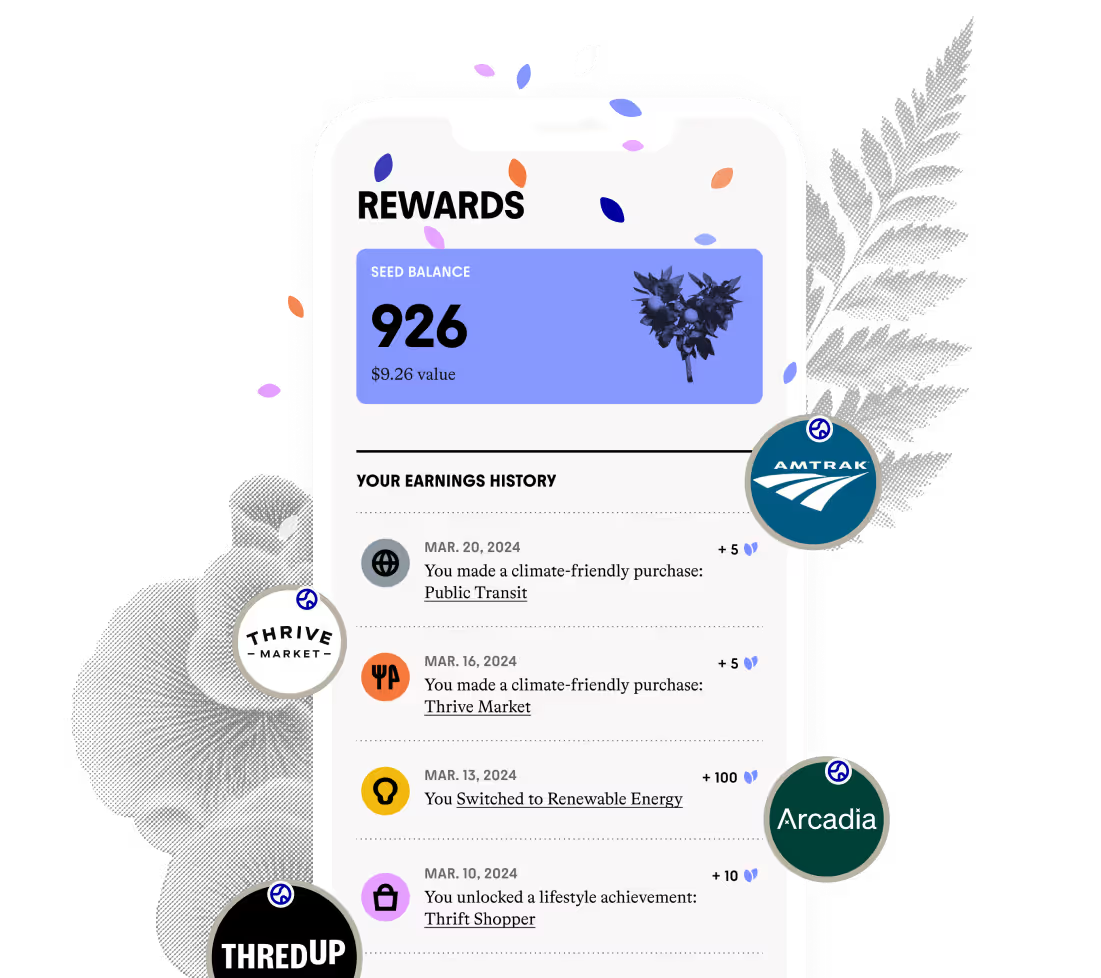
Join thousands of people saving money and earning rewards through sustainable living, only on the app.

Commons team hiking
Commons Team
January 6, 2026

A No-Buy Challenge Might Just Change Your Life
Do you feel like you’re drowning in advertisements, clutter, or debt? A no-buy year could help. In a capitalistic society, we're brainwashed to default to buying our way out of our problems. That's what makes a no-buy challenge so much more than a New Year's resolution or an extreme budget.

A no-buy or low-buy challenge not only gives you permission to hop off the buy-buy-buy hamster wheel — it also makes you more privy to sneaky marketing and helps you put your money toward what actually makes you happy. These are the kinds of mental shifts that could stick with you for life.

In this episode, we hear from listeners about the different ways to do a no-buy or low-buy year, and what they've learned about themselves and their finances in the process.

Want to submit your Community Classified? We'd love to hear from you! Want to try no-buy challenge join the Commons community, download the app.

Episode Credits

  • Listener contributions: Amandine Thomas, Cara Sanford, Daria, Justina, Melissa Tan
  • Editing and engineering: Evan Goodchild‍
  • Hosting and production: Katelan Cunningham

Full Transcript

Katelan (00:00):

Welcome back to Second Nature, a podcast from Commons where we talk to people about how they're living sustainably. In an unsustainable world, it's not easy to pass up a sale, at least not for me. I grew up deal hunting, so if I saw something at a really good discount, even if I didn't need it, I couldn't pass it up because it felt like it was too cheap to pass it up. I've had to actually deprogram myself from that train of thought because you know what's cheaper than buying the thing that's on sale, not buying it. One thing that helped me deprogram myself from this kind of thinking was doing a no by year with the New Year's Resolution discourse in full swing, you may be reflecting back on the past 12 months to consider what you wanna pursue or reimagine, and the next 12 months, maybe you are reflecting on all the clothes in your closet that you barely wear, or that trending makeup that you bought because you saw it on TikTok or all those Amazon receipts in your inbox. Now withhold the judgment because what is a new year, if not a fresh start?

Katelan (01:14):

If you feel like you're drowning in advertisements, clutter, or debt, A no by year could help. To me, a no by year isn't about restriction as much as it is revelation observation. It's permission even to slow down and gut check your trained instinct to bye bye bye. A no by year can look however you want it to. Really in its strictest form, it's a year where you don't buy any non necessities. So no clothes, no excess makeup, no tech, et cetera, but you don't have to do it that way. There are many variations where you can spend less in areas that make sense for you. For example, you could choose one type of thing not to buy like clothes or tech or Starbucks coffee, or you could put a limit on that type of thing for a sort of low buy year. Say you buy one latte each week instead of one every day.

Katelan (02:11):

You could also consider not buying anything new for a year when you need or want something. You'd ask your buy nothing group check, thrift stores or secondhand marketplaces online. Your no by year could be a year of not buying anything online. This would encourage you to shop local wherever possible, and slow down your purchase cycle just enough that you probably won't buy as much stuff. You could also consider not buying from big box stores like Amazon or Target. What you gain from a no buy year isn't just more cash in your pocket. A great no buy year can help you realign your money with what you care about most. It can encourage you to find opportunities to connect with community resources, learn to repair what you have, embrace more circularity, and it can help you remove yourself from the vicious cycles of trends and consumption. I'm your host, Kaitlyn Cunningham, and on this first community episode of the season, we're gonna hear from you about how your noby years have changed your buying habits, your relationship with stuff, and what you learned about yourself along the way.

Amandine (03:18):

A couple of years ago, I decided that my New Year's resolution would be to not buy any new items of clothing, and I was already buying a lot of secondhand clothing anyway on Facebook marketplace or you know, in op shops. I love op shopping. Australia has a lot of amazing op shops, so I thought it wouldn't actually be that hard to stop buying new, and I noticed that some of the brands that I liked were actually not that great in terms of sustainability. So I just wanted to be a little bit more true to my beliefs and actually <laugh> put a little bit more effort into living a lifestyle that aligned better with my values. Um, the guidelines for my No Buy <laugh> couple of years, um, whether I wouldn't buy anything, whether it was online or whether it was in shops, I wouldn't buy any items of clothing that were new and that only excluded things like, you know, underwear, sleepwear, sportswear, because it's sometimes a little bit easier to find these things <laugh> in, um, in op shop or or in marketplace.

Amandine (04:29):

So these were my, my roles. Um, the first year I actually, I didn't specifically include shoes as well or accessories, but it just so happened that I didn't buy any new shoes or any new accessories or bags or anything like that. I ended up finding, you know, if I needed boats, I found boots at the op shop, et cetera. Um, but when I started my second year, I decided to intentionally include accessories. You know, that might be hats, that might be shoes, bags, all of that into my nearby year. And when I tell people that I haven't actually bought anything new for that long, people think, oh, but it must be hard because what if you need this particular item? You know, what if you need a white shirt for work and you have to go to all these op shops, so you have to scour the the norby groups, but it's actually really, really not that hard.

Amandine (05:28):

That was the best learning out of this <laugh>. It's really not that difficult. If I need something, I'll have it at the back of my mind, and when I go to the up shop, I will look specifically for the item I need, or I will just go on marketplace. Oh, I will just go, you know, on the Nobis group and, and request say, Hey, does anyone have a size eight, uh, white shirt, blah, blah, blah. And, and it's actually really easy, and that inspired me to maybe go further and try to look at other things that I might not need to buy new. If I need a new printer or if I need new headphones, do I really need to go and buy new ones when I could just get a perfectly good one that is working, that is in good order, um, that someone wanna get rid of? It's actually really been great. I went to a wedding recently and my entire outfit cost less than $30 and people were complimenting my shoes and I had bought the shoes at the op shop. They were complimenting my dress. I actually got the dress for $2 at the OB shop and they were complimenting my earrings, and that was also an optional buy. So I'm hoping that maybe I can inspire people around me to see that it's really not that hard.

Melissa (06:43):

I've done lots of no buy because I just leveraged on communities very early on in my zero waste practice. I use Buy Nothing projects, I host clothes swaps. And it really made me realize that we have so much that we have in our house already and so much that exists in other people's homes that they're not really using as well. So when you recirculate them and really get the utility out of them, you start to realize that a lot of things that you use, you only use it for certain occasions or for perhaps a project, and that's it. So as an aspiring minimalist, that really helped me in shaving off the inclination to buy even more. I didn't wanna clutter up my house. So when I revert to community first through borrowing, through swapping and through sourcing through the secondhand marketplaces, it kind of kept me away from the shops.

Melissa (07:36):

And then it became a whole new game and a whole new muscle that I exercised of how resourceful can I be in the art of making due instead of relying on my credit card to try and solve my problems. So in the last six years, I've only bought two or three basic tops, some underwear and some socks. So things that are probably not advisable to get secondhand. The guideline for a no by year might seem simple, is just to not buy. But how you navigate that is how you can come up on top. When I have a need, I would first of course resort to what I have at home and how I can be resourceful with it. It also helps you to really reflect how much of this a need and how much of this is a want. And after that, if what I have at home does it serve, then how can I rely on community to be able to access that?

Melissa (08:27):

Whether it is true borrowing, true swapping or true, going on a buy nothing project and getting it for free by free cycling within the community, these steps also take time. So that time allows you to marinate on whether this is truly a need or whether it was a temporary one, and that time allowed it to just dissipate into the air. It really gives you space between an impulse and your actions. So that space is very freeing. You're not just reacting to every impulse that you have, you're allowing it to sit with you to be honest with yourself, and to let it reconcile within, uh, without it having an impact onto the other world and your wallet. My no, by years have been great. It feels like a form of liberation. It's not perfect, but through this like exercising of that muscle, I feel like I'm really not susceptible to marketing anymore.

Melissa (09:27):

What has been an added bonus is my journey into minimalism, because even if things are showing up at my house through free cycling or swapping, I realize they don't stick around for long. And my discernment for the things that I really enjoy and truly bring value into my life gets stronger and stronger. So now, not only am I not buying things, I'm also not allowing things that even if they're free or they're free cycling or they have been swapped, I'm not allowing them to just enter my life if they're not really fulfilling a specific and useful purpose or they really add value to my enjoyment of material things. Because I'm also avoiding spending hundreds of dollars every single month on these random purchases. It also relieved the financial pressure and the pressure to take on jobs that would have compromised my own personal values in order to meet those financial demands.

Daria (10:24):

Many years ago, I decided to stop buying new clothes because I just think that textile waste is such a horrible problem, and it's one of those problems which could be solved pretty easily if just more of us buy clothes more intentionally if we don't support fast fashion brands generating trash. And so for me, the rule was that, I dunno, buy any new clothes. Whenever I need something new, I look for it in secondhand platforms first. I mainly shop online, although I check out thrift shops if I'm passing by one and I have time for that, obviously that's just, uh, fun, <laugh> nice thing to buy for me. I just ended up finding pretty much everything secondhand. I even bought like gym class, which is completely new, <laugh> and great. I keep using it. I have like a 4-year-old leggings, which are still going strong, t-shirts, sneakers, coats, knitwear, whatever else I need.

Daria (11:20):

I bought pretty much all of it on secondhand platforms, and that really helped me ditch my habit of buying new clothes through cheaper brands like h and m Zaa. I did make exceptions for shoes because it's just really hard to find secondhand shoes that fit, and I feel that the offer is just smaller. And I really think that after going for a couple of years of just buying stuff secondhand, I really changed my attitude towards clothes. I am trying to find my own personal style, and actually the amount of money I spend on clothes has decreased, and the amount of time I spend shopping has also gone down, and it has been going down continuously because I have a full wardrobe and it's high quality clothes, and I just do not need to buy much stuff. So I think over time my wardrobe will shrink, and as I said before, I sell a lot of stuff I did not need. So I think it's really, really helpful and it kind of spills over into other areas of life because for example, whenever we need new tableware, we look for those secondhand platforms.

Justina (12:31):

I learned that I spent too much money on coffee and sweet treats. Yeah, I, I discovered that I use it often as a reward after a hard day at work or after a tough day at the gym. It was a learning curve for sure. I mean, it's good to enjoy it once in a while, but just not in excess. Um, I also discovered that when I buy less, I'm also using less. So it made me think about how much stuff I have that I don't actually use. So that's another journey in itself because it really helped me simplify my lifestyle. I also gained a new found love for trying new recipes because I did spend more time in the kitchen.

Cara (13:15):

I'm currently doing my No, by year. I started it in January of 2025. I had considered doing it for a year before, but putting it into action and following through, I had considered it because my goals in life have changed. Like I really want to save up for a house and I wanna be able to live comfortably. And my spending habits previously were just not reflecting that. I'm also becoming really aware that overconsumption is not good for the planet, and I am in the process of still learning every day how to live more sustainably. My first step was to unsubscribe to all the SPAN emails for retailers. So anything that was like an email about sales or trying to give me coupons. And I also stopped consuming content from creators on social media, like influencers that try to make you buy something or over consume themselves, things that I can spend money on, bills gas, groceries, um, any hobbies.

Cara (14:11):

So this includes subscriptions such as Disney plus, Netflix, et cetera. As I do watch TV sometimes, but I mostly do just spend money on, like, I spent money on baseball during the summer. Speaking of baseball, I consider anything that's going towards my health and wellness, something I can spend money on. I can also use money to buy experiences. So, but by that I mean date nights with my boyfriend, though I will admit he does pay for most of the day nights, but you know what I mean. Um, any friend outings, but again, while spending money on date nights or outings with my friends, I have to like, I make it a rule to suggest doing free things such as going on picnics, going for walks, going to the park, going to the library. If I don't choose something that's free, I try to pick a local place to go.

Cara (15:04):

And then the last thing I can buy is gifts for other people. But I have to try to be sustainable as possible and choose something I know for sure would not go to waste things. I'm not allowed to buy books <laugh> because I have enough books. If I really want to read a book, I can go check it at at the library. I feel like libraries are underrated. You can find just about anything at a library. Now, if you search for it, you can go get books, you can get DVDs, magazines. There's free things always going on at the library. Free classes. You just have to look clothing. So I must try to fix them first if I'm able to. And if not, it has to be something I need. Speaking of something I need, I can only replace a product if I need it, and I've used up the previous product already.

Cara (15:56):

For example, I can't buy a new tube of mascara unless I finished the current tube that I have. In June. I quit my full-time job and started working part-time only making half of the wage that I usually did per month. And at first I was really worried I wasn't going to be able to afford my bills, but by July I realized I was able to live pretty much the same as before because my spending habits had become better. By August, I started working full time again, and I would say since then I did break some of the rules, like I went and bought some clothes, but I did get them secondhand. But I need to commit to this plan again and I'm working on it, and I would like to continue this for the rest of my life.

Katelan (16:42):

I too did a low buy year in 2024, I decided to only buy six items of clothing all year, new or secondhand at the end of it. And I didn't expect this, but I felt like I got to know myself better because I was thinking more about what I bought before I bought it. And by doing that and slowing down, I got to know what I truly love and what I don't. I got better at figuring out the difference between the clothes I love to look at and the clothes I love to wear. I reckoned with the fact that I definitely over consume at thrift stores. I learned that I shouldn't buy souvenir clothes. <laugh> and I saved hundreds of dollars. It's been a year since then and all these lessons are still permanently ingrained in me. My clothing purchases are still very minimal, even though I'm not practicing a clothing lo by year.

Katelan (17:36):

And honestly, it was life changing and really freeing, not just for my bank account, but for my psyche too. If you're contemplating starting a no by year for close or anything else, I hope you got some helpful inspiration and tips from our community. Like most new challenges, it's often more difficult at the beginning, but it does get easier. You can do it and you don't have to go the whole year. Start now. Give it a month or a quarter, see how it goes. Maybe we'll do a six month check-in episode to see how we're all doing. By the way, if you wanna check your progress, the Commons app has a no by Challenge feature. You just choose what you wanna spend less on this month, you set your budget and it'll help you track your progress. For January, I'm working on ordering less takeout. You should check it out. Thank you to everyone who called in to share about their noby experiences. On today's episode, you heard from.

New Speaker (18:34):

[credits]

Katelan (18:50):

This episode was edited and engineered by Mr. Evan Goodchild. It was written and produced by yours truly. Katelan Cunningham, before you go, we'd love if you could review the show. Commons is a startup, so we have to think a lot about the projects we choose to invest our time and resources in. And it'd mean a lot if you could let us know what you're thinking of the show, and don't forget to stick around for one more minute for community classifieds to hear the ways that you can get involved locally in all kinds of climate work. I hope to catch you back here next week. See you then.

Ali (19:24):

Hi everyone. I'm Ali Wines founder and CEO of the Climate Communications Alliance. Working in the climate space can be incredibly fulfilling, but we all know that it's challenging too, especially right now when it can feel like someone has turned the volume down on the most important conversation of our times. But there is a way to make our voices louder. There's incredible evidence showing us how to shift people from simple climate awareness into real sustained action using behavioral insights and communication strategies that are proven to work. The Climate Communications Alliance is a global community of practice dedicated to advancing these evidence-based approaches. We help communicators tap into that research to amplify their impact and drive the change we so desperately need. We're a friendly, welcoming, and fast-growing community with members now on every single continent. If you're ready to find your support system and level up your impact, come join us. Let's change the conversation together. Find us at www.climatecommsalliance.org. We can't wait to meet you.

Yelle (20:34):

My name is Yelle and I'm involved with Women and Climate, a global organization. The Women and Climate Community provides a joyful and safe space for women and non-binary professionals from around the world to learn about and talk about climate, no climate experience necessary. The org's mission is to accelerate climate action by inspiring more women to get started on their climate journey and empowering women who are already working on climate. Today I am a volunteer content creator for Women in Climate, focused on producing the Let's Talk Climate series that prompts women to speak up more about climate on their social media. The org is always looking for more volunteers and city leads. Who are those that host events in cities around the globe?

GET THE APP

REWARDS FOR GREEN LIVING

Earn rewards when you shop at sustainable brands that are measurably lowering emissions.
Screenshot commons app
get the app

EARN REWARDS FOR SUSTAINABLE SPENDING

From thrift stores to public transit, earn rewards on thousands of climate-friendly purchases.