How to Pick a Debt Payoff Plan You Can Stick With


Join the community



Key Takeaways
- The debt avalanche targets your highest-interest debt first to save money, while the debt snowball targets your smallest balance first to build momentum.
- Both methods follow the same payment plan. Pay the minimum on every debt, put extra money toward one balance, and roll its full payment into the next debt once it's paid off.
- Your plan can change with you. You can start with the snowball to clear a small balance, then switch to the avalanche to reduce interest costs.
The average American carries $6,329 in credit card debt. With everyday costs rising, many people carry more debt than they ever planned.
If your debt is less than 36% of your gross income, you can pay it off with two simple methods: the debt avalanche and the debt snowball. They don't require new credit, and you can start today.
This guide will help you choose the one that fits your budget and the way you think about money.
What Is the Debt Avalanche Method?
The debt avalanche method targets your highest-interest debt first. You pay the minimum on everything else and put any extra money toward that one high-rate balance. Once your highest-interest debt is paid off, you start paying more aggressively on the debt with the next-highest rate, and so on.
Since you clear your most expensive debt first, the avalanche saves you the most on interest and can help you become debt-free sooner.
Here's how to use the debt avalanche method:
- List your debts (not including your mortgage) from the highest interest rate to the lowest.
- Calculate how much extra, beyond your minimum payments, you can put toward debt each month.
- Put your extra money toward the debt with the highest interest rate until you pay it off. Whichever debt has the highest interest rate will be your “focus debt.”
- Pay the minimum on every other debt.
- When you’ve paid off your first focus debt, roll the amount you were paying onto the debt with the next-highest rate.
- Repeat until you pay off every balance.
Say you have these three debts and $300 extra each month:
- A $1,800 personal loan at 8.9% interest
- A $3,600 credit card balance at 18.9% interest
- A $6,200 credit card balance at 24.9% interest
You'd pay the minimum on all three and add the extra $300 to the $6,200 card at 24.9% first. Once it's paid off, you'd roll its full payment into the $3,600 card, then tackle the personal loan last.
The avalanche is a strong fit if you enjoy working with numbers, feel motivated by watching your interest costs shrink, and feel comfortable waiting a while for your first payoff. It's also a good choice if one debt has a much higher rate than the rest, since every month on that balance costs you more.
It can feel slower if your highest-rate debt also has a large balance. You might pay on it for many months before you see it disappear, and that's a long time to go without a visible win.
What Is the Debt Snowball Method?
The debt snowball method targets your smallest balance first, no matter its interest rate. You pay the minimum on everything else and put your extra money toward that smallest debt. Once it's gone, you add what you were paying on it to the next-smallest debt. Your payment keeps growing, like a snowball rolling downhill.
Here's how you can use the debt snowball method:
- List your debts (not including your mortgage) from the smallest balance to the largest. Set interest rates aside for now.
- Calculate how much extra money you can put toward debt.
- Put your extra money toward the smallest debt until you pay it off. Whichever debt is the smallest will be your “focus debt.”
- Pay the minimum on every other debt.
- When you’ve paid off your first focus debt, roll the amount you were paying onto the debt with the next-smallest debt.
- Keep rolling your freed-up money forward until you pay off every balance.
Say you have the same three debts and $300 extra each month:
- A $1,800 personal loan at 8.9% interest
- A $3,600 credit card balance at 18.9% interest
- A $6,200 credit card balance at 24.9% interest
You'd pay the minimum on all three and add the extra $300 to the $1,800 personal loan first, even though the credit cards charge more interest. Once it's paid off, you'd roll its full payment into the $3,600 card, then tackle the $6,200 card last. The goal here is a quick win that builds momentum.
The snowball is built for momentum, not math. Paying off a debt, even a small one, gives you a real sense of progress. It also means one less bill, one less due date, and one less thing on your mind each month.
That feeling matters. Paying off debt often takes years, and motivation naturally dips along the way, especially when life brings surprise expenses or a tighter month. Early wins can help you keep going when the finish line still feels far away.
You can add "debt snowflakes" to speed things up. These are small day-to-day savings, like making coffee at home a few times a week, that you add to your snowball payment. Every little bit counts.
Debt Avalanche vs. Debt Snowball
Both methods ask you to pay the minimum on every debt and put extra money toward one target at a time. The difference is which debt you target first.
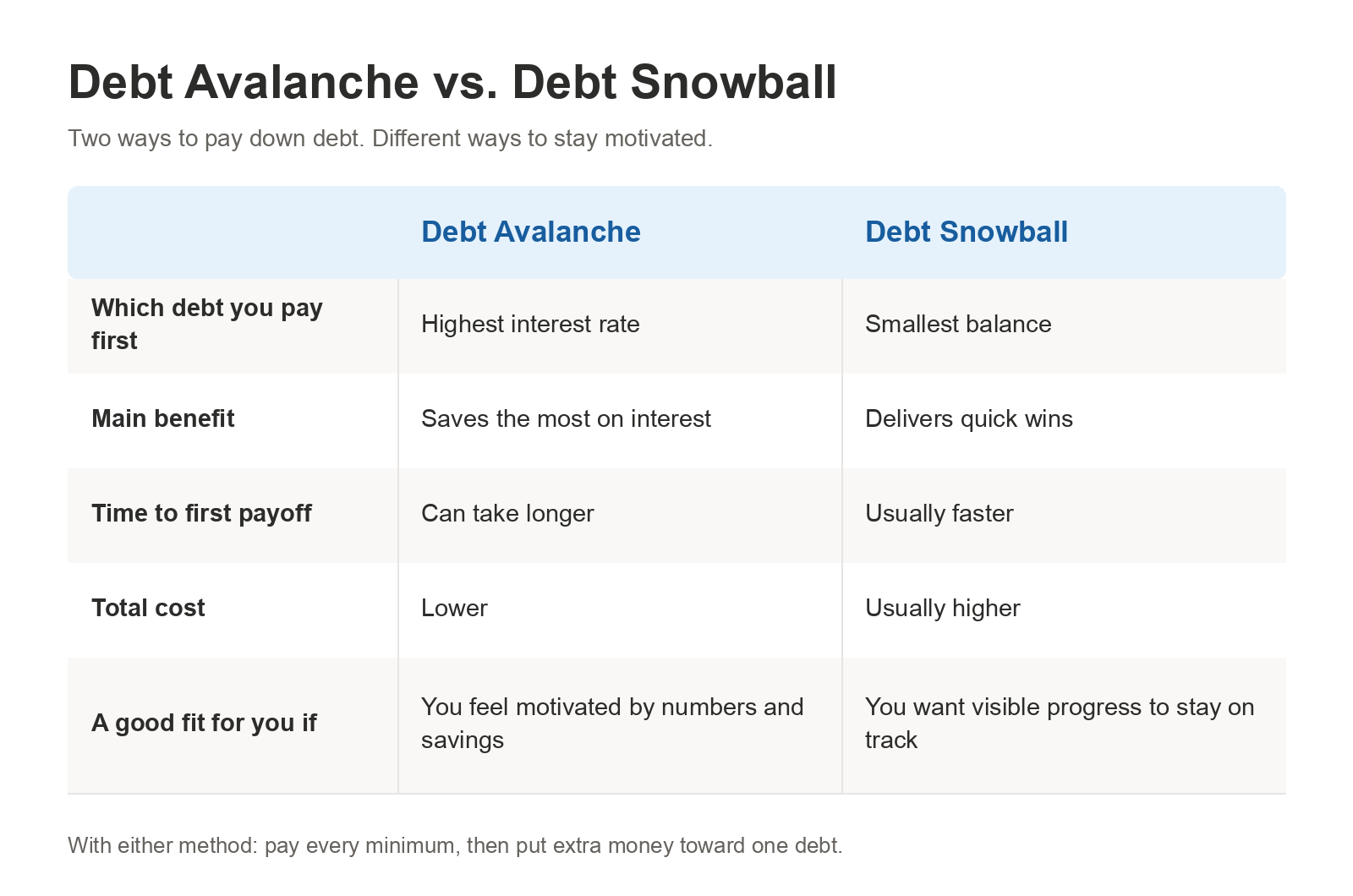
To see how the gap adds up, look at the interest on the examples above. Using the annual rate divided by 12, the $6,200 card at 24.9% costs roughly $129 in interest for a month, while the $3,600 card at 18.9% costs about $57, and the $1,800 personal loan at 8.9% costs about $13. Actual charges depend on payment timing and how the lender calculates interest. The snowball targets the smallest balance first, while the avalanche goes straight to the card costing you the most in interest.
The snowball usually costs a bit more in interest. That gap is often modest, but it grows when one balance carries a much higher rate than the others. The avalanche saves you money, but it may require more upfront patience.
How Can You Choose Based on Your Debt Profile and Personality?
The right method depends on your balances, your interest rates, and what keeps you motivated. Here are a few questions to help you decide.
The snowball can be a good fit for you if:
- You've started a debt payoff plan before and want a fresh approach that builds momentum.
- You can realistically pay off your smallest debt within about three months.
- You have several small balances and want fewer bills to track.
- Your interest rates are fairly close, which keeps the extra interest cost low.
The avalanche can be a good fit for you if:
- One of your debts has a much higher rate than the rest.
- Your largest debt is also your highest-rate debt. With the snowball, you'd pay the most expensive balance last.
- You feel motivated by tracking how much interest you're saving.
- You're comfortable waiting longer for your first payoff.
You can also combine the two. Some people start with the snowball to knock out one or two small balances, then switch to the avalanche once they have momentum and more money freed up. Your plan can change as your situation does.