Unplasticing Your Life Doesn’t Have to Cost a Fortune

.svg)
.svg)

Join the community



I often feel as though I’ve been forcibly wrapped in a layer of cellophane. Plastic on my skin, in my clothing, permeating the air I breathe. It’s an inescapable facet of reality that sounds dystopian, but the clocks are striking thirteen in 2026 rather than 1984.
This feeling is becoming all the more oppressive with the rise of social media “hauls” and “restocks”: endless rows of plastic containers filling drawers that were already perfectly capable of holding our possessions. Twenty-two individually wrapped makeup remover wipes, fifteen Rhode lip balms, eight scents of the Touchland hand sanitizer, all falling into their artificial place. The clicking sounds of contact between products become almost hypnotic, luring you to follow suit, right into the fires of plastic-wrapped overconsumption.
In the media, sustainable swaps are often painted as a more costly option. But when overbuying becomes the norm, this sentiment no longer rings true.
I work part-time here at Commons, and part-time at a local Vermont farm picking berries. I just moved out of my parents’ house three months ago, and now have bimonthly grocery visits to keep up with, a thirteen-year-old car to take care of, and many, many bills. I don’t have much money left over, so when it comes time to decide where it should go, the pressure is on.
I’ve always known, though, that any cent I can spare should go to helping the planet however much I can. Since plastic is the baseline of modern life, I always assumed deviating from that path would be difficult and undefinably costly. I couldn’t have been more wrong.
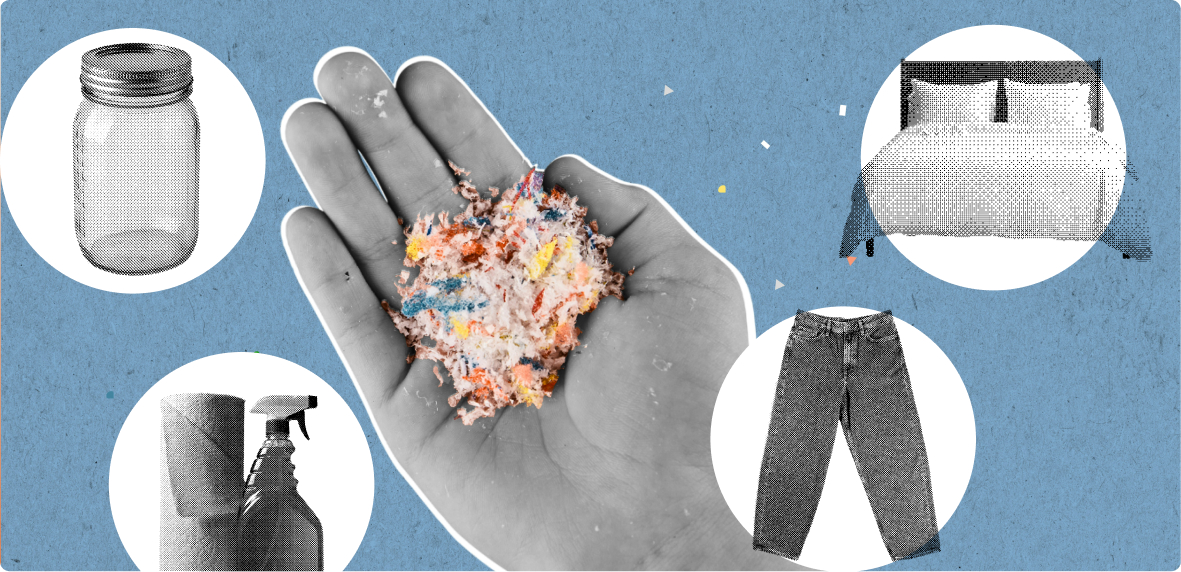
Here’s how I switched out four pillars of plastic in my daily life:
High-Touch Plastics
These are your clothing pieces, food accouterments, toothbrushes, sponges, and other plastic-based items that we use every day.
Food storage
- Instead of the classic polypropylene containers, I switched to using glass ones. This was the most expensive switch for me, especially since I replaced everything all at once. The set I chose was $22 for 4 pieces. While a similar pack of plastic ones was $4.29. So I spent $17.71 more on this swap. Metal containers is also a fantastic option if you’re thinking of moving away from plastic. I didn’t buy any purely because glass looked better with the dishware I already owned.
- If you’re anything like me, every shopping trip requires the purchase of at least three jars of pasta sauce (viva l'Italia!). Cleaning out and saving them when you’re done is my fav sustainability hack. You can use them as vases for flowers, storage for cotton balls, as drinking cups… the list goes on! This clean/save practice means you have an automatic, sustainable option on hand when new needs arise, at no extra cost.
Clothing
Synthetic fabrics, like polyester, acrylic, and nylon trap dirt and bacteria against your skin, and make it so your body can’t properly regulate its temperature. I’ve made a conscious choice over the past few years to wear only cotton, linen, wool, silk; fabrics that work with your body, not against it.
100% natural fiber pieces are affordable and easy to find if you just start paying attention to the fabric tag. My favorite summer skirt (linen/cotton blend) was $2 at Goodwill.
Toothbrush
Did you know that for every two minutes of teeth brushing with a plastic head, you’re ingesting up to 120 microplastic particles? I didn’t, hence why I have a fully plastic electric toothbrush sitting in my bathroom right now… evilly.
I plan to switch to bamboo and am eyeing this one ($4.99) from Grove.
Heavy Shedders
Daily-use items that release the most microplastics into our environment, i.e., bedding, rugs, towels. Check out our Second Nature, “Can We Recycle Our Way Out of the Plastic Crisis?” episode to hear about just how prolific plastic is in our homes, and its devastating effects.
Bedding
Sheets, comforters, or blankets made with synthetics shed microplastics with each touch. These fibers are so small you can even breathe them in… not ideal for getting a restorative night's sleep. Plus, every wash of these textiles sends over 2000 particles directly down the drain.
My 100% cotton sheet set was $55 full price, but I got them for $30 on sale. Similar polyester/nylon ones are $27.99, so it cost me about $2 to make this swap.
Fish Stranglers
Items that flow with water into the public supply. You know the “All drains lead to the ocean” saying from Finding Nemo? It’s not too far from the truth. Laundry detergents, dish soaps, and toilet cleaners are all sources of microplastics in our oceans.
Laundry Detergent
We’ve already touched on synthetic fabrics being washed into the water system, but what about the surfactants you use to wash them? Switching from liquid pod detergent to sheet alternatives is a great way to reduce your microplastic footprint.
My favorites are the lavender-scented Clean Cults, at $13.99 a box, just $1 more than a container of your classic Tide Pods. These fully dissolvable plant-based detergent sheets come in all cardboard packaging. No plastic whatsoever.
Toilet cleaner
This one was a tough switch for me! I usually like to clean the toilet using as many chemicals as possible. About a month ago, I was heading out of the store, Clorox in hand, when I saw these Clean Cult ones on an end cap. I was hesitant at first, but they really clean! And now fewer harsh chemicals are going down the drain, and zero plastic is involved in the whole process.
My old faithful Clorox was $2.89 per bottle, with corrosive, toxic sodium hypochlorite as its main ingredient. The Clean Cult ones are $3.10 more, at $5.99 a box.
General Disposables
Things we need to throw away
I don’t have too many purely disposable products, but my two main ones are the Reel brand for toilet paper and Caboo for paper towels. Both of these items come in paper packaging, on a cardboard roll, and use only bamboo for the fabric. It replaces the alternative – bleached paper from felled trees in plastic wrapping.
- Reel toilet paper is $15.99 for a 12-pack, vs the leading brand at $10.99 for a 12-pack.
- To buy six rolls of Caboo, I spend $19.99. The leading brand costs $16.99.
- I spend a net of $8 more each time I buy these products.
The Cost to Start Unplasticing My Life
To have a clear conscience and feel as though I’m living in line with my ethics, I spent $24.70 more than the average consumer to set up my sustainable life. I’m going to spend $12.10 more per month to keep up with my choices. All things considered, those are prices I can happily live with.
Here's the math:
Initial investments: $24.70
These are infrequent purchases that will last me years
- Glass food storage: $17.71
- Reusing pasta jars: $0
- Buying natural fibers: $0
- Toothbrush: $4.99 more
- Bedding: $2 more than a synthetic set
Refills and reups: $12.10
These are consumables I'll need to replace when I run out.
- Laundry sheets: $1 more than what I was buying before.
- Toilet cleaner sheets: $3.10 more than what I was buying before.
- Paper towels & toilet paper: $8 more than what I was buying before.


%202.svg)